
Indiquez le type et le grammage du papier choisi pour les bâtiments, les toits ou les petits détails.
Comment réagit-il à l’impression, au pliage et au collage ? Une photo et le type d’imprimante faciliteront les comparaisons.







Construisez, partagez, discutez et améliorez ensemble votre ville en papier.

Indiquez le type et le grammage du papier choisi pour les bâtiments, les toits ou les petits détails.
Comment réagit-il à l’impression, au pliage et au collage ? Une photo et le type d’imprimante faciliteront les comparaisons.
Indiquez le type et le grammage du papier choisi pour les bâtiments, les toits ou les petits détails.
Comment réagit-il à l’impression, au pliage et au collage ? Une photo et le type d’imprimante faciliteront les comparaisons.
Ian Wilson:
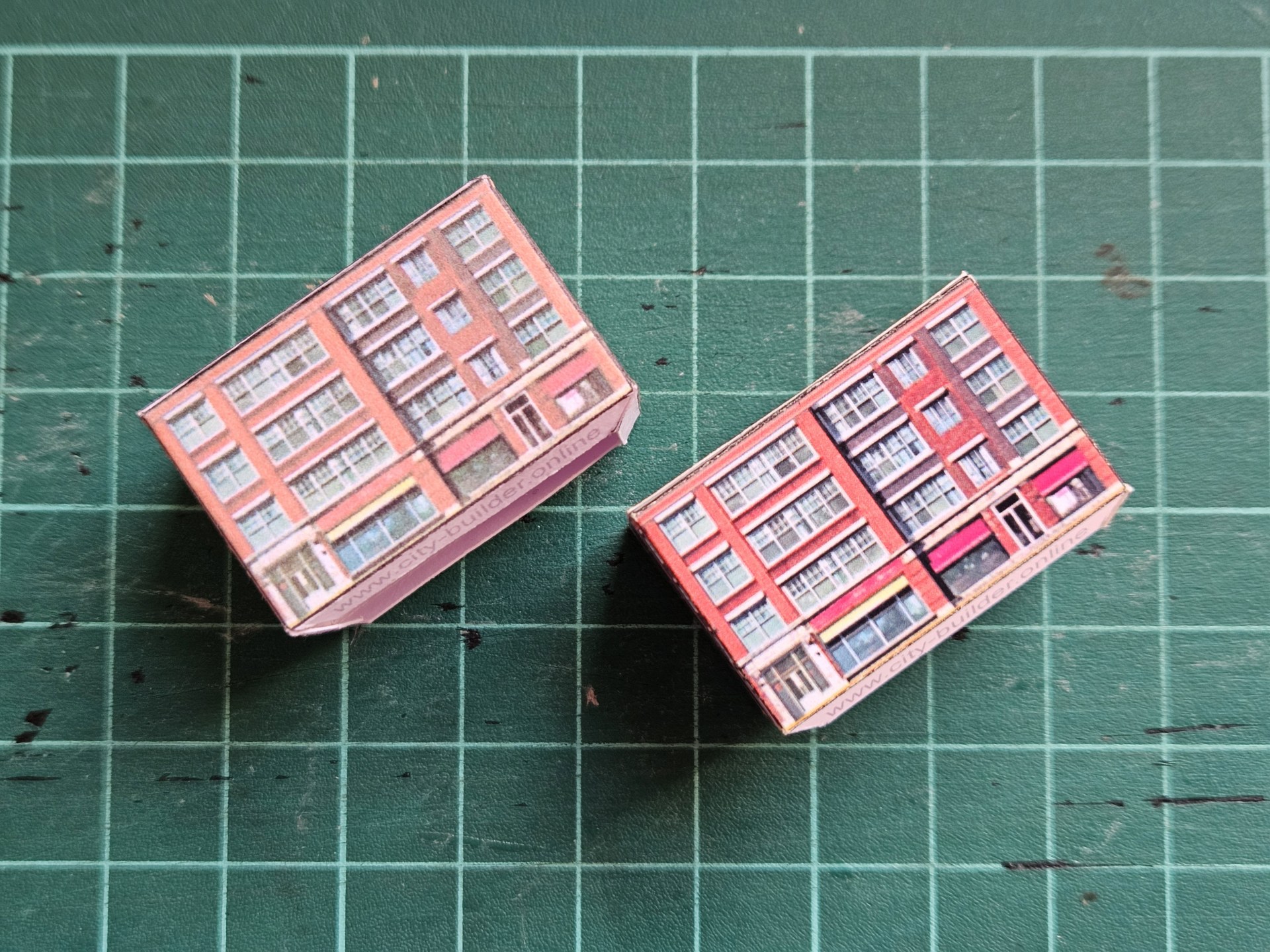
Paper is the simplest thing but it also the trickiest. It needs to cut and fold nicely, to glue easily without going all crinkly and to take printer ink cleanly. I think that last it the hardest. I've been using some A4 white 180 gsm card from Hobby Craft in the UK. It is, if anything, on the heavy side. I do like its solidity, it makes pretty bomb-proof little buildings! On the down side it only prints fairly well. It's not bad but the detail is lost a little from the ink bleeding and that also makes the colours a little less bright and clear. I've just come across a pack of "Premium Coated Inkjet Paper" which I bought years ago from WH Smiths (again, in the UK) It is 120 gsm so as light as I'd want to use and the lightest which Yurii recommends. I've tried printing on it and the colour and detail is much better than on the standard paper. I've just made my first small building with it and am pleased with how well it seems to work. It doesn't feel as tough as the same building made with 180 paper (thin card really) but the colours, on that coated paper, are nice. I printed out and made up a train with it and the extra detail on that rather tiny model did make a great improvement. It also works better for the tiny things like trains and trams. I found the thickness of the 180 paper made the trains harder to make well. I will certainly be making the smaller items with the 120 coated paper from now. I may still use the 180 for larger buildings where the extra stiffness might be more important. Of the two buildings pictured the one on the left is printed on standard 180gsm card, the one on the right is on the coated paper. It's just that little bit clearer and brighter.
Oh yes, I can definitely relate to this. I actually started out using 200 gsm paper, and I quickly discovered that it was just too much for me. The buildings were certainly strong, but some of the smaller folds and details were really difficult to work with. It felt more like I was fighting the paper than building the model sometimes.
At the moment, 150 gsm seems to be the sweet spot for me. I’m happy with the colours I get from my printer, and the finished buildings are still quite solid without being difficult to fold and glue.
Your comparison between the 180 gsm standard card and the 120 gsm coated paper is really interesting, especially what you said about the trains and trams. I can absolutely see how thinner paper would help with models that small. At that size even a small difference in paper thickness becomes quite noticeable.
I think experimenting is really the key here. Different paper weights, coated and uncoated papers, and even different brands can behave surprisingly differently. The same printer can give noticeably different colours, sharpness and detail depending on the surface of the paper.
Thanks for sharing your experience and the comparison. It’s genuinely useful to see what other people are getting good results with. I may have to try some coated paper myself for the smaller models.

Des créateurs et modélistes du monde entier.

De nouveaux contenus et magazines sont publiés régulièrement.

Une question ? Nous sommes là pour vous aider.

Nous collaborons avec des créateurs, des communautés et des marques.